


Atmospheric Circulation
There are both global and local circulations of the air around us. Scientists have different terms for the circulation based on how large the air movements are. They say macroscale to describe wind currents that are on a global scale. Mesoscale describes storms like thunderstorms or blizzards. There are also winds and small circulations that only last for a few seconds. These smaller circulations are described with the term microscale.Around The Neighborhood
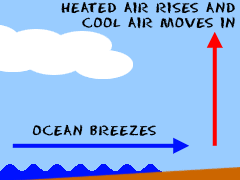 Let's talk about local winds first. Sometimes you're outside of your house and you feel a breeze. There are very fast winds high in the atmosphere, sometimes moving at hundreds of miles per hour. The unequal heating of air masses creates those winds. Those air masses are actually a big chunk of warm air and a big chunk of cold air.
The unequal heating and temperature differences also create a pressure difference, and the warmer gases spread out because the molecules need more room. All of these differences cause the molecules of air to move from one area to another. That air movement is the wind. When you open a soda can you are hearing wind coming out (so to speak). The gas rushes out because of the difference in pressure.
Around The World
Let's look at the larger winds of the Earth called global winds. What about the huge, monstrous winds that circle the globe? What about the trade winds that helped sailors cross the Atlantic and Pacific Oceans? Scientists use the term cells. There are enormous cells of wind that wrap around the Earth. The winds that blow in the cells are created by temperature and pressure differences but also because of the spin of the Earth. The effect of the spinning Earth is called the Coriolis Force.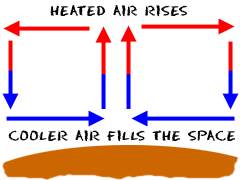
Building Cells
A big part of circulation is due to temperature differences. Think about the Earth. It is warmer in the middle than on the top and bottom. The poles are colder than the equator. When warm winds want to move north, the cold winds need to move south and fill the empty space. Can you picture the cell being built? It's a big rotation of the gas molecules in the atmosphere.


Or search the sites for a specific topic.
- Overview
- Composition
- Temperature I
- Temperature II
- Pressure
- Circulation
- Interaction
- Coriolis Force
- Greenhouse Effect
- More Topics

Imported Dust in North American Skies (NASA/GSFC Video)


Useful Reference Materials
Encyclopedia.com:http://www.encyclopedia.com/topic/Atmospheric_circulation.aspx
Wikipedia:
http://en.wikipedia.org/wiki/Atmospheric_circulation
Encyclopædia Britannica:
http://www.britannica.com/EBchecked/topic/41463/atmospheric-circulation
 Go for site help or a list of earth science and geography topics at the site map!
©copyright 1997-2015 Andrew Rader Studios, All rights reserved.
Current Page: Geography4Kids.com | Physical Geography | Atmosphere Basics | Atmospheric Circulation
** Andrew Rader Studios does not monitor or review the content available at external web sites. They are paid advertisements and neither partners nor recommended web sites. Specific links for books on Amazon.com are only suggested starting points for further research. Please browse, research options, and choose the appropriate materials for your needs.